Guide
Printable math worksheets for grades 1 to 6
Twenty-problem PDF worksheets on addition, subtraction, multiplication and division, each with an answer key on its last page.
Updated
Some are free. The rest are 1 credit each: buy one for $2, or get 5 credits for $5. Yours to keep.

Worksheets by grade
Each grade starts with its free sets, so you can see whether the level fits before you spend anything. Then come a few more sets and the grade bundle, which puts a run of sets at one price.



Grade 1 Number Foundations
10 items · 6 credits
Grade 2
All grade 2 worksheets


Grade 2 Subtraction Mastery
8 items · 5 credits
Grade 3
All grade 3 worksheets


Grade 3 Math Complete
22 items · 14 credits
Grade 4
All grade 4 worksheets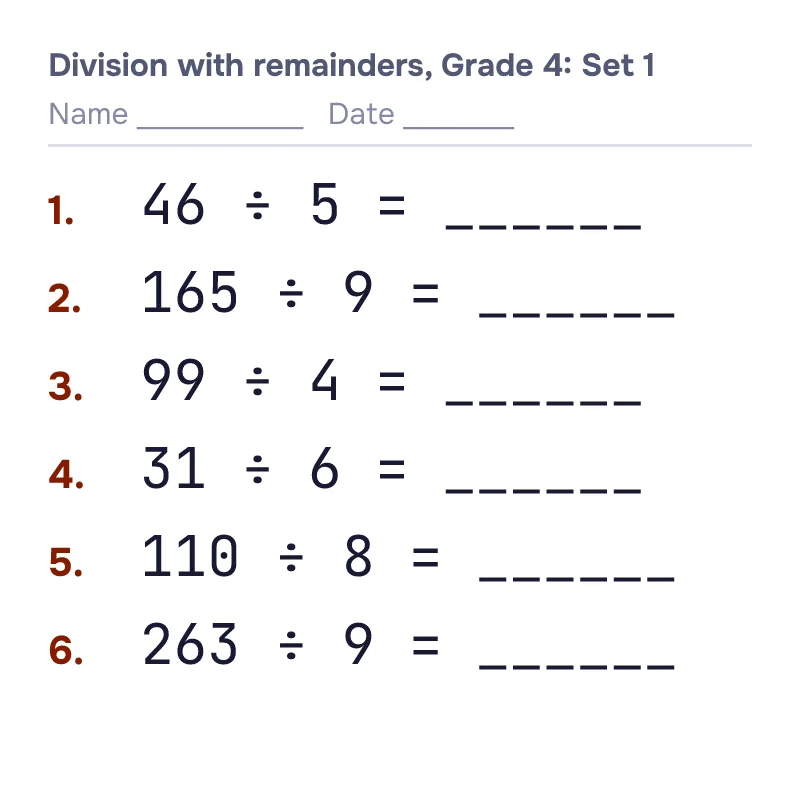


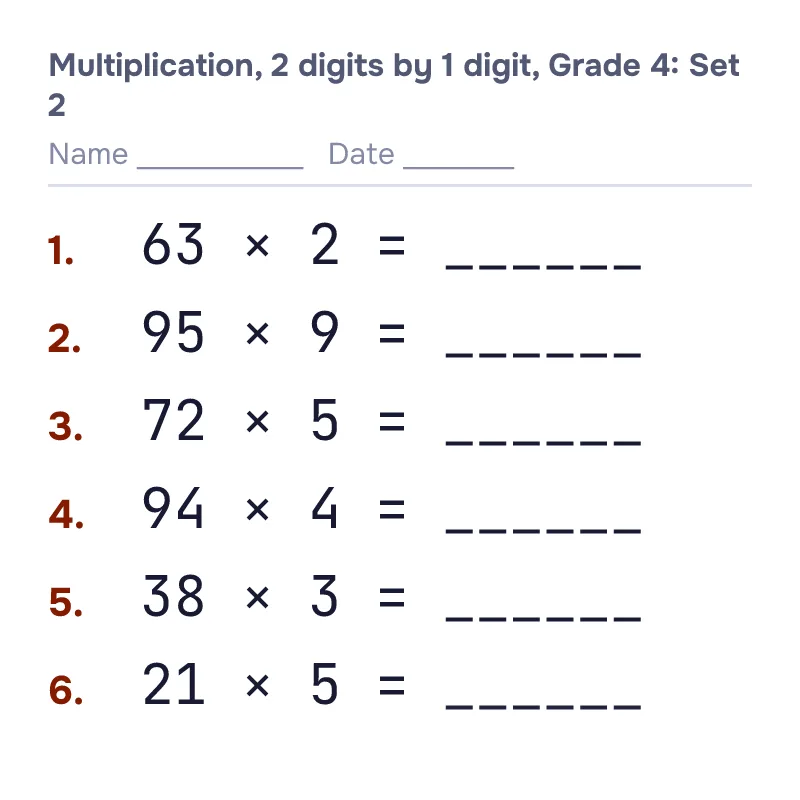


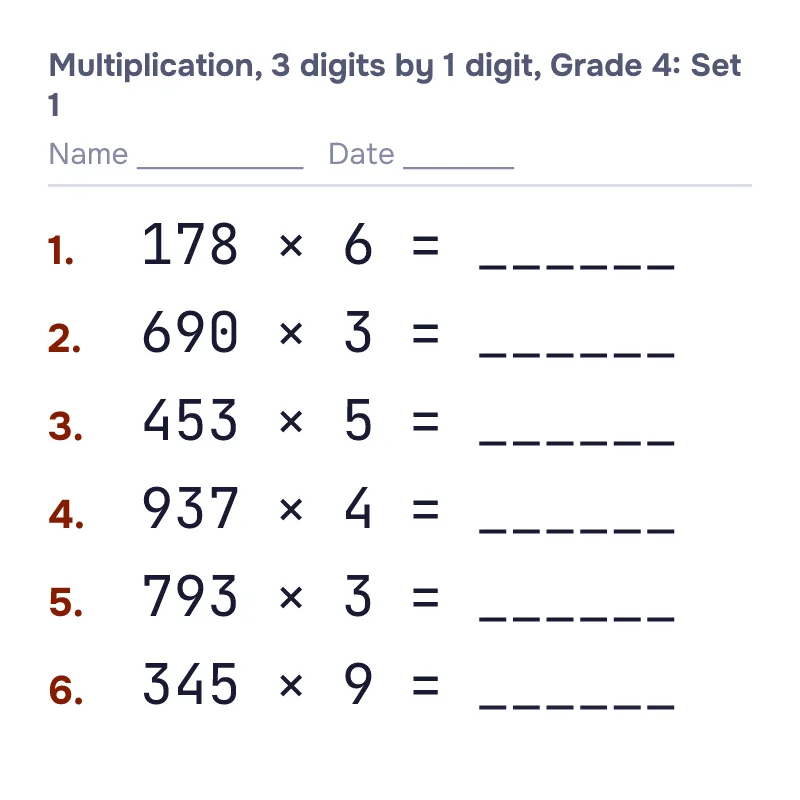
Grade 4 Multiplication and Division
12 items · 8 credits
Grade 5
All grade 5 worksheets

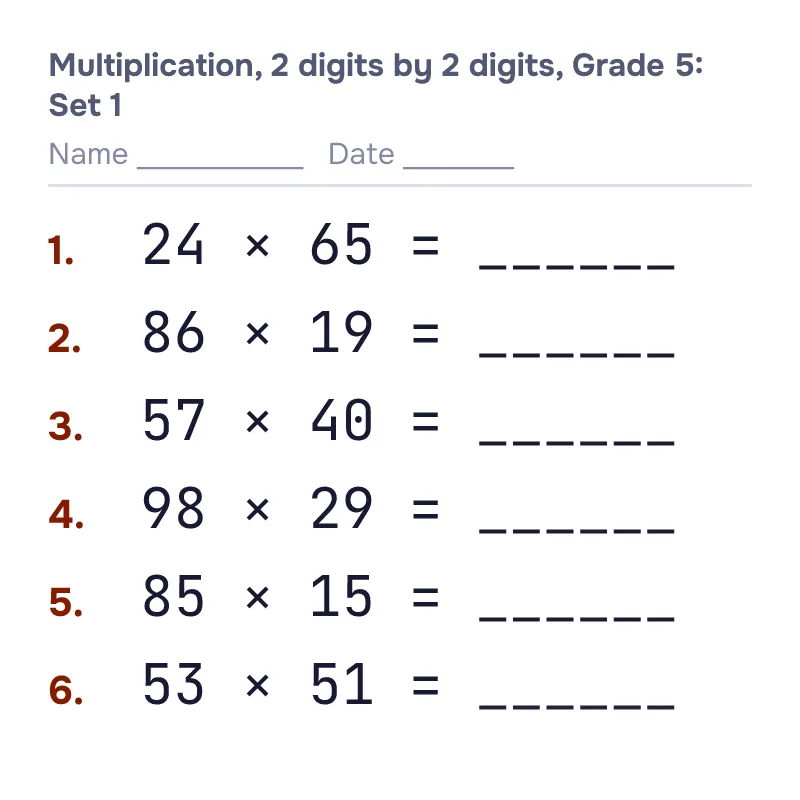


Grade 5 Multiplication Mastery
10 items · 6 credits
Grade 6
All grade 6 worksheets
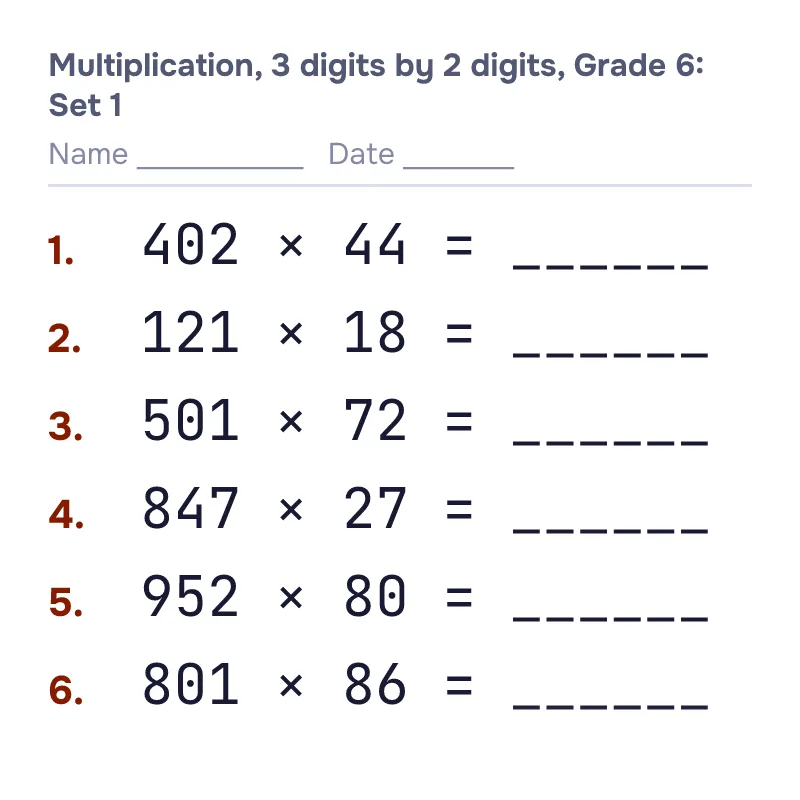



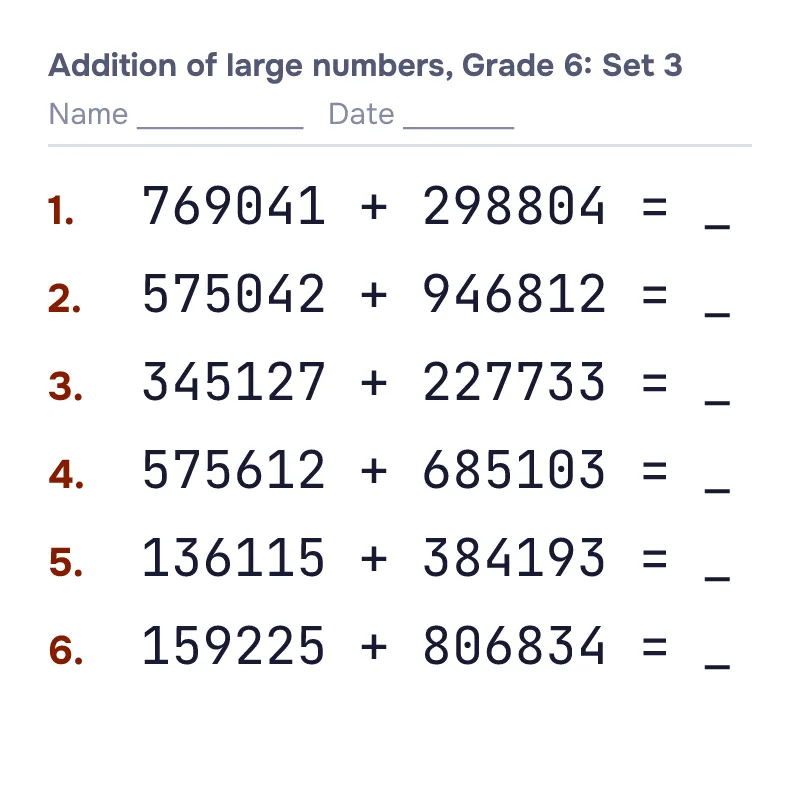
Grade 6 Long Division and Big Numbers
10 items · 6 credits
Who this is for
- A parent helping at the kitchen table.Your child needs a few more minutes on one skill, such as times tables, and you want a page you can print now, without an app or a screen.
- A teacher planning a warm-up or early finisher.Each set is one skill at one grade with ten problems per page, so it fits the start of a lesson. The answer key on the last page makes marking quick.
- A teacher or tutor checking where a learner is.Print Set 1 of a skill as a quick check, then use later sets of the same skill, which have fresh numbers, for follow-up practice.
- A homeschooling family.A grade collection gives you a run of related sets that can anchor a few weeks of practice, with one price instead of many small ones.
- Anyone reviewing over a break.Pick the grade just below the one your child is entering and work forward. Starting slightly easy makes the first sessions a success.
How to use it
Pick the skill, then the grade
Every title names both, for example Multiplication facts, Grade 3. If you are unsure, choose the grade below and move up. Confidence matters more than speed in the first week.
Try a free Set 1 if there is one
Some skills have a free Set 1. Download it (a free account is needed) and give it to the learner before deciding what else to get. Watch which problems slow them down.
Print pages 1 and 2, keep page 3
Each file is a PDF of three US Letter pages. Pages 1 and 2 hold ten problems each, with a Name and Date line at the top. Page 3 is the answer key, so print only the first two for the learner. On A4 paper, choose the scale to fit option in the print dialog.
Work one page at a time
Ten problems is a short sitting. Let the learner work the page alone, then mark it together with the key. Circle the misses without comment and talk about them after.
Repeat the misses, then move on
Ask the learner to redo only the problems they got wrong the next day. When most of a set is right, move to the next set of the same skill: it has fresh numbers, so it is new practice, not a repeat.
What a worksheet looks like
These are the real preview pages. The watermark is only on the previews, and the file you download is dark text on white, so it prints cleanly on any printer.
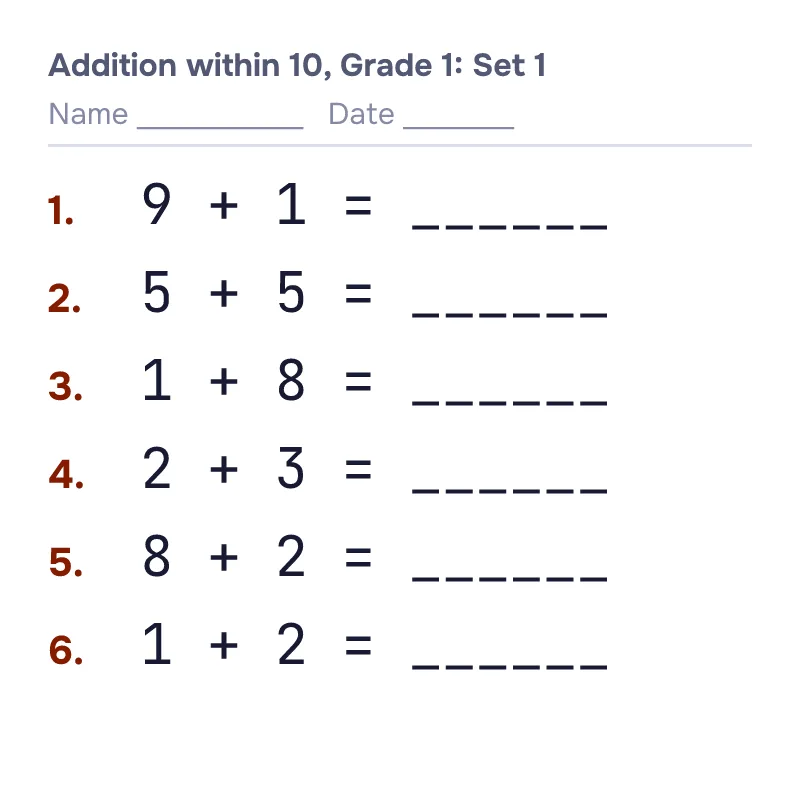
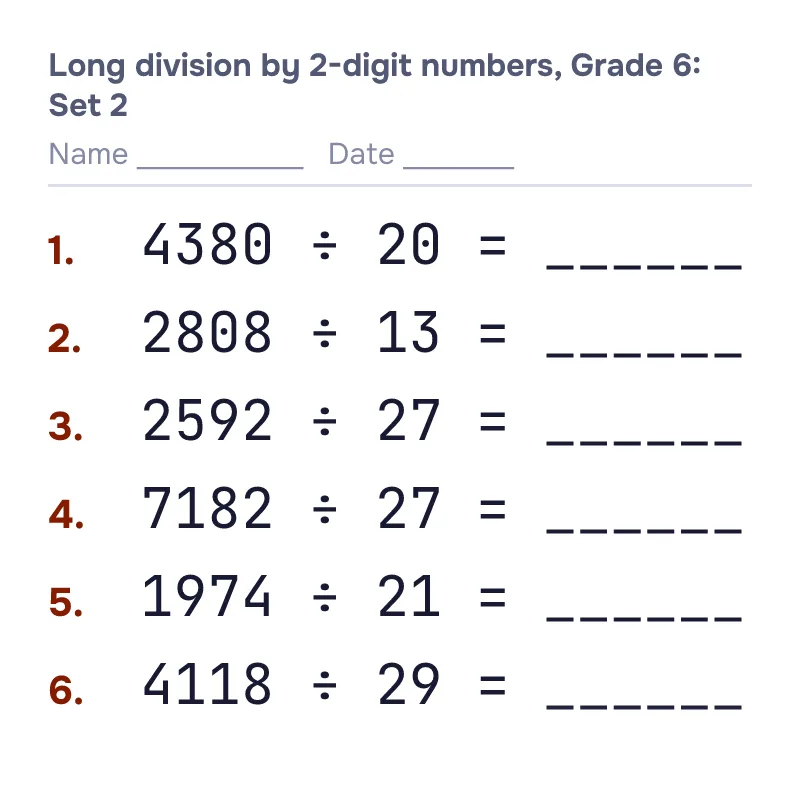
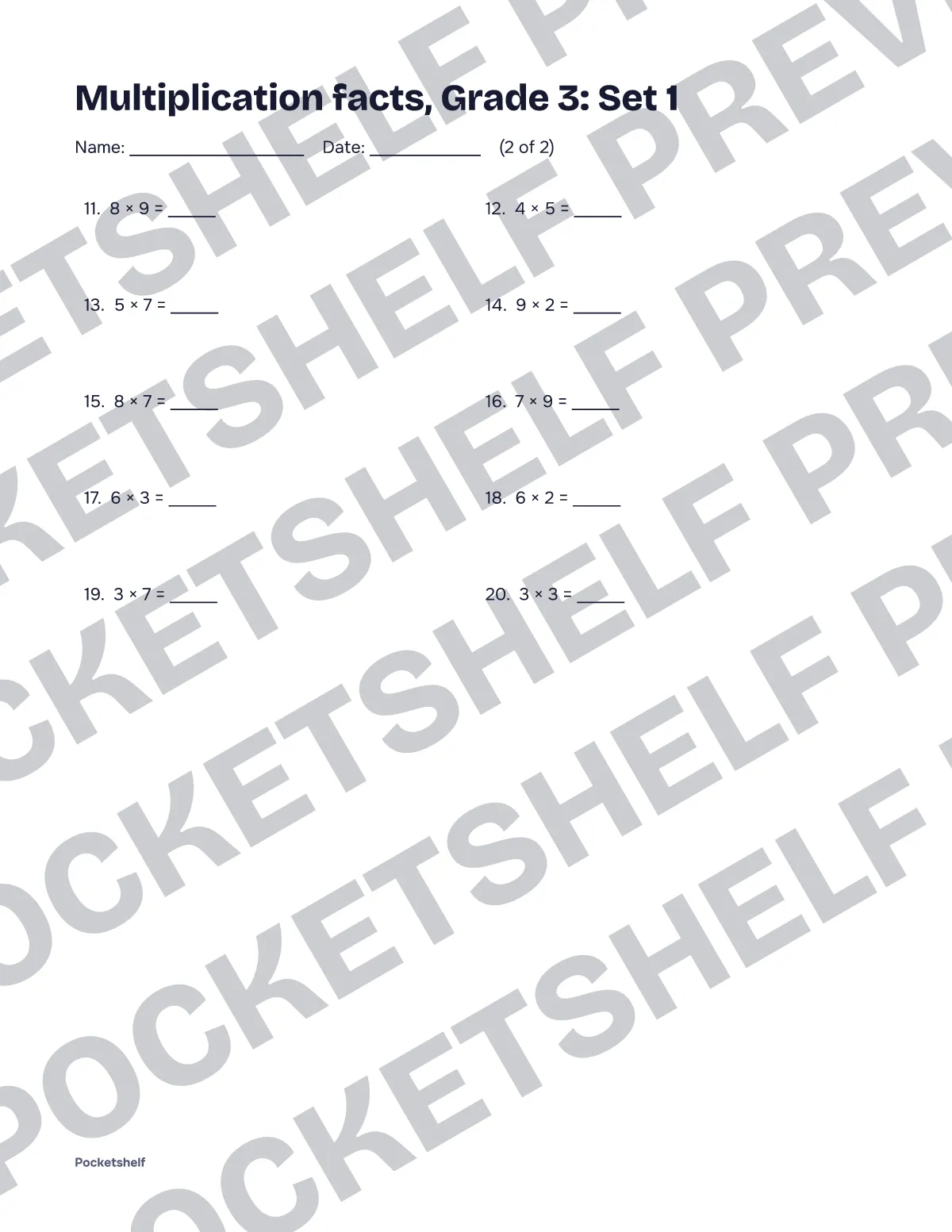
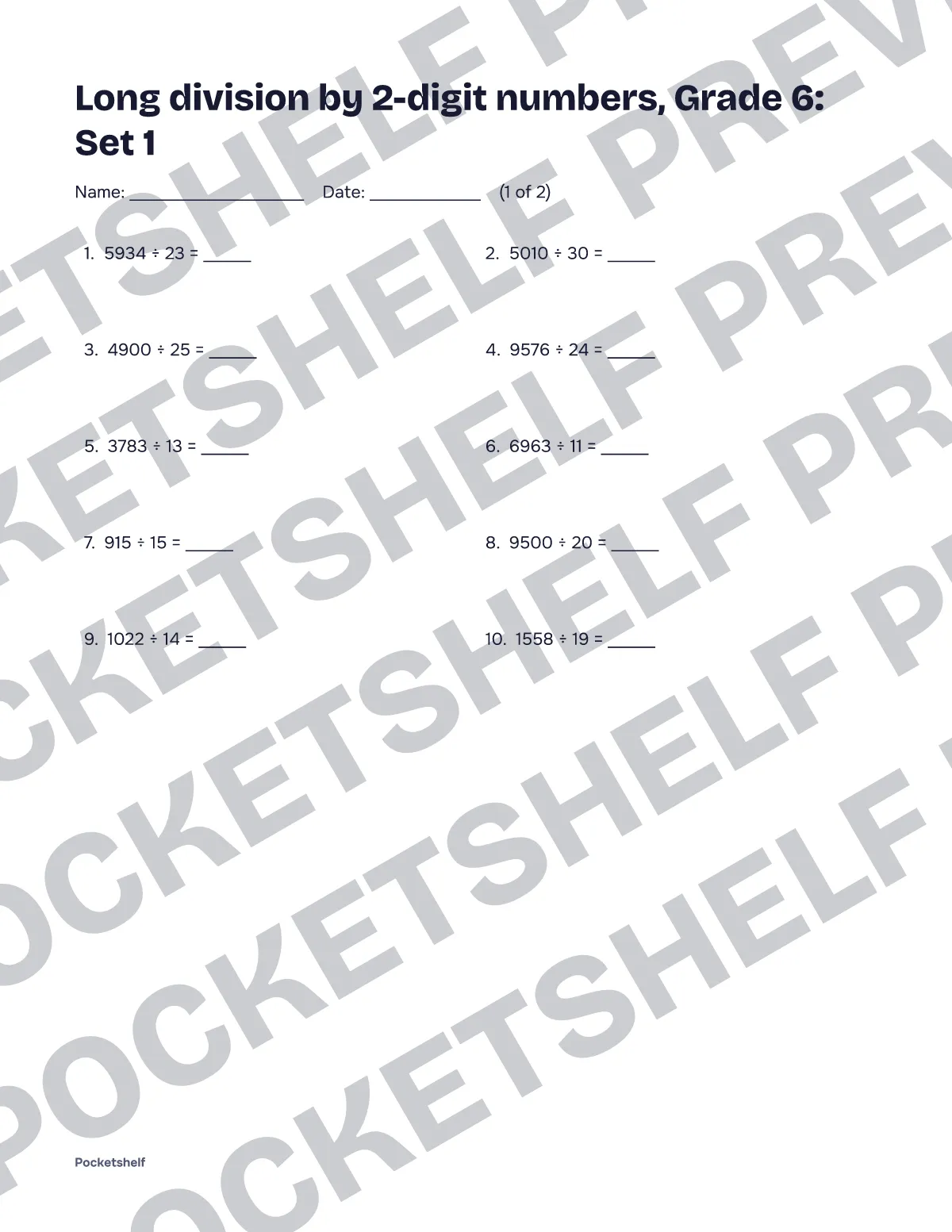
Grade 1: addition within 10The same layout at every grade, with problems in two columns and space to write the answer on the line. The first grade sets use small numbers, so a young learner can count or picture them. View full size of Grade 1: addition within 10 (opens the image in a new tab) Grade 3: multiplication facts, page 1Problems 1 to 10 with a Name and Date line and a page marker, 1 of 2. Ten problems on a page leaves room for working and keeps one sitting short. View full size of Grade 3: multiplication facts, page 1 (opens the image in a new tab) Grade 3: multiplication facts, page 2Problems 11 to 20, marked 2 of 2. The answer key is a third page in the PDF and is not shown in previews, so you can hand the learner pages 1 and 2 and keep the key. View full size of Grade 3: multiplication facts, page 2 (opens the image in a new tab) Grade 6: long division by 2-digit numbersGrade 6 uses the same page with bigger numbers. Problems are written on one line, so the learner sets out the long division on the page or on scrap paper. View full size of Grade 6: long division by 2-digit numbers (opens the image in a new tab)

What is in a single set and in a collection
A single set is one skill at one grade: 20 problems on two pages, then an answer key page, as one PDF. A collection is several sets, sometimes across skills, at one price. The counts and prices below come straight from the shelf.
Grade 1: first addition facts.
- Files
- License
- personal
Grade 2: borrowing across tens.
- Files
- License
- personal
Grade 3: times tables.
- Files
- License
- personal
Grade 4: division with remainders.
- Files
- License
- personal
Grade 5: two-digit products.
- Files
- License
- personal
Grade 6: long division.
- Files
- License
- personal
| Item | Best for | Files | License | Price |
|---|---|---|---|---|
| Addition within 10, Grade 1: Set 1 | Grade 1: first addition facts. | personal | Free | |
| Subtraction with regrouping, Grade 2: Set 1 | Grade 2: borrowing across tens. | personal | 1 credit | |
| Multiplication facts, Grade 3: Set 1 | Grade 3: times tables. | personal | Free | |
| Division with remainders, Grade 4: Set 1 | Grade 4: division with remainders. | personal | Free | |
| Multiplication, 2 digits by 2 digits, Grade 5: Set 1 | Grade 5: two-digit products. | personal | Free | |
| Long division by 2-digit numbers, Grade 6: Set 1 | Grade 6: long division. | personal | Free |
- Grade 1 Number Foundations6 credits
10 items. Bought one by one: 10 credits, so the kit saves 40%.
- Grade 2 Subtraction Mastery5 credits
8 items. Bought one by one: 8 credits, so the kit saves 38%.
- Grade 3 Math Complete14 credits
22 items. Bought one by one: 22 credits, so the kit saves 36%.
- Grade 4 Multiplication and Division8 credits
12 items. Bought one by one: 12 credits, so the kit saves 33%.
- Grade 5 Multiplication Mastery6 credits
10 items. Bought one by one: 10 credits, so the kit saves 40%.
10 items. Bought one by one: 10 credits, so the kit saves 40%.
| Kit | Items | Kit price | Bought one by one |
|---|---|---|---|
| Grade 1 Number Foundations | 10 | 6 credits | 10 credits (kit saves 40%) |
| Grade 2 Subtraction Mastery | 8 | 5 credits | 8 credits (kit saves 38%) |
| Grade 3 Math Complete | 22 | 14 credits | 22 credits (kit saves 36%) |
| Grade 4 Multiplication and Division | 12 | 8 credits | 12 credits (kit saves 33%) |
| Grade 5 Multiplication Mastery | 10 | 6 credits | 10 credits (kit saves 40%) |
| Grade 6 Long Division and Big Numbers | 10 | 6 credits | 10 credits (kit saves 40%) |
How to choose a grade without guessing
Grade labels are a guide, not a verdict. A child can be fluent with addition and still shaky on subtraction across tens, so choose by skill first. The worksheets follow a common order:
In grade 1 the sets cover addition and subtraction within 10 and within 20, and missing addend problems. Grade 2 moves to numbers within 100 and to regrouping. Grade 3 is where multiplication and division facts begin, alongside three-digit addition and subtraction. Grade 4 adds multi-digit multiplication, division with remainders and a first look at long division. Grade 5 builds from two-digit to three-digit products and longer long division. Grade 6 covers long division by two-digit numbers and arithmetic with large numbers.
If a learner finds a set easy, take the next grade of the same skill. If it is a struggle, go back one grade and come forward again. Neither is a failure; it is just finding the right start.
A practice routine that fits ten minutes
Short sessions are easier to start and easier to keep going. One page of ten problems, three or four days a week, is a routine most families can hold.
A simple fortnight looks like this. Use the first set of a skill on Monday and mark it together. On Wednesday, redo only the misses and then try the second set. On Friday, work a third set and compare how many you got right with Monday. In the second week, choose a new skill, and slip in one older set every few days so earlier work does not fade.
Because every set has fresh numbers, you can return to a skill after a few weeks without the learner remembering the answers. That is what makes five sets of one skill more useful than one set printed five times.
Using the answer key well
The answer key is the last page of each PDF, laid out in four columns and numbered to match the problems. Every answer in it has been checked against the problems on the pages. Division problems with a remainder write the answer as a quotient and a remainder, for example 5 R 3, so teach the learner to expect that form.
When you mark, look for patterns before counting. Three misses that all involve carrying are one problem, not three. Name the pattern, show one worked example, and let the learner redo just those. A set with one clear pattern is worth more than a set with a perfect score.
Questions people ask
Do the worksheets have answer keys?
Yes. Every worksheet PDF ends with an answer key on its own page, numbered to match the problems. The answers are checked against the problems on the pages. The key is not shown in the previews.
How do I print them?
Each file is a PDF on US Letter paper: two pages of problems and one page of answers. Print pages 1 and 2 for the learner and keep page 3. On A4 paper, choose the scale to fit option in your print dialog. The pages are text on white with no colour fills, so any printer will do.
Are the sets different from each other?
Yes. For each skill and grade there are several sets, and each one uses fresh numbers, so Set 2 is new practice rather than a copy of Set 1. Titles end in the set number so you can keep track.
Which curriculum do these follow?
We do not claim alignment with a particular curriculum or standard. Each title names the skill and the grade, so you can match it against your own syllabus or your child's school plan before you choose.
Can I use them in my classroom or with students?
The Personal license covers use with your own family and with students or classes you directly teach, including printing copies for them. It does not cover reselling, sharing the files publicly or using them in a service you sell. If you run a paid tutoring business, read the license page or email us before you buy.
How do credits work?
Credits pay for items that are not free, and each item shows its price in credits. Credits come in packs, starting at 5 credits for $5, and are valid for 12 months from the day they were added. If you only want one item, you can buy it directly for $2 without buying a pack. Free items need no credits, only a free account: enter your email, choose a password and confirm the link we send you.
What if a worksheet has a mistake?
If a file is broken or not what we described, open your library within 7 days of unlocking it and choose Request refund. The credits come back as store credit and the item is removed from your library. Free items are not refundable, because no credits were spent on them. Card refunds are handled by email at our discretion, and the full policy is on the refund page.
Ready to pick one?
Some are free. The rest are 1 credit each: buy one for $2, or get 5 credits for $5. Yours to keep.